Prompt engineering fundamentals
Use case
Khanmigo एक AI-powered tool है जो Khan Academy से है जिसे वे "Learners के लिए Tutor। Teachers के लिए Assistant" कहते हैं। यह छात्रों के लिए व्यक्तिगत सीखने के अनुभव प्रदान करता है। यह छात्रों को गणित, विज्ञान, और मानविकी की समस्याओं पर मार्गदर्शन, एक बहस उपकरण, और एक लेखन ट्यूटर प्रदान करता है। यह शिक्षकों को कई कार्यों में सहायता कर सकता है, जैसे कि एक शिक्षण सहायक। इस ब्लॉग में, हम देखेंगे कि कैसे Khanmigo की कुछ क्षमताओं को दोहराया जा सकता है जो विशेष रूप से शिक्षकों का समर्थन करने के लिए डिज़ाइन की गई हैं।
एक प्रभावी सीखने के अनुभव के सबसे महत्वपूर्ण तत्वों में से एक पाठ का हुक है। पाठ का हुक एक रणनीति है जिसका उपयोग शिक्षक छात्रों का ध्यान आकर्षित करने और उनकी भागीदारी बनाए रखने के लिए करते हैं, जो पाठ के मुख्य सामग्री में प्रवेश करने का एक बिंदु के रूप में कार्य करता है। पाठ का हुक कई रूप ले सकता है—जैसे एक विचार-प्रेरक प्रश्न, एक इंटरैक्टिव गतिविधि, एक त्वरित खेल, एक छोटी कहानी, या एक आकर्षक उपमा। प्रत्येक विषय भागीदारी के लिए कई कोण प्रदान करता है। एक अच्छी तरह से तैयार किया गया हुक न केवल ध्यान आकर्षित करता है बल्कि विषय वस्तु को छात्रों के जीवन से भी जोड़ता है, जिज्ञासा को जगाता है और उन्हें गहराई में जाने के लिए प्रेरित करता है।
Creating lesson hooks
हर विषय के लिए अद्वितीय हुक बनाना चुनौतीपूर्ण हो सकता है, खासकर जब कई कक्षाओं का प्रबंधन करना हो या विभिन्न छात्रों के सेट को संबोधित करना हो। LLMs का उपयोग करके, शिक्षक जल्दी से रचनात्मक, विषय-विशिष्ट हुक उत्पन्न कर सकते हैं जो विभिन्न सीखने के स्तरों के लिए अनुकूलित होते हैं।
Automating quizzes
एक बार पाठ पढ़ाने के बाद, शिक्षक के लिए अगला कार्य छात्रों की स्मृति का आकलन करने के लिए एक परीक्षण तैयार करना होता है। क्विज़ बनाना एक थकाऊ कार्य हो सकता है। LLMs का उपयोग करके, शिक्षक क्विज़ निर्माण प्रक्रिया को स्वचालित कर सकते हैं।
Prompt Structure
OpenAI API के साथ बातचीत करते समय, प्रॉम्प्ट के तीन प्रमुख भूमिकाएँ होती हैं: system, user, और assistant।
Roles
- system: उस मॉडल के व्यवहार को मार्गदर्शित करने के लिए एप्लिकेशन डेवलपर द्वारा परिभाषित निर्देश शामिल हैं।
- user: एप्लिकेशन के अंतिम उपयोगकर्ता द्वारा प्रदान किया गया इनपुट।
- assistant: मॉडल की प्रतिक्रिया, जो उपयोगकर्ता इनपुट पर सिस्टम निर्देशों को लागू करके उत्पन्न होती है।
Large Language Models (LLMs) को इस भूमिका-आधारित ढांचे के भीतर निर्देशों को व्याख्यायित करने के लिए अनुकूलित किया गया है। सिस्टम प्रॉम्प्ट वे निरंतर निर्देश हैं जो मॉडल को प्रदान किए जाते हैं। जबकि यह वैकल्पिक है, यह सिस्टम प्रॉम्प्ट (जैसे, “Input वाक्य का भावनात्मक वर्गीकरण करें। किसी अन्य प्रश्न का उत्तर न दें।” ) स्वचालित रूप से प्रत्येक उपयोगकर्ता संदेश के साथ जोड़ा जाता है, जिससे इसे हर बार मैन्युअल रूप से लिखने की आवश्यकता समाप्त हो जाती है।
सिस्टम संदेशों(system prompt) का उपयोग लगातार व्यवहार को लागू करने और मॉडल को नियंत्रित सेट के निर्देशों तक सीमित रखने में मदद करता है। चूंकि अंतिम उपयोगकर्ता सिस्टम संदेशों को संशोधित नहीं कर सकते हैं, इसलिए प्रॉम्प्ट इंजेक्शन या दुरुपयोग का जोखिम काफी कम हो जाता है।
उपयोगकर्ता और सहायक भूमिकाएँ सक्षम करती हैं: - इंटरैक्टिव अनुभवों के लिए मल्टी-टर्न वार्तालाप। - मॉडल के आउटपुट को मार्गदर्शित करने के लिए आदर्श प्रतिक्रियाओं का प्रदर्शन।
एक सामान्य प्रॉम्प्ट संरचना नीचे चित्रित की गई है। 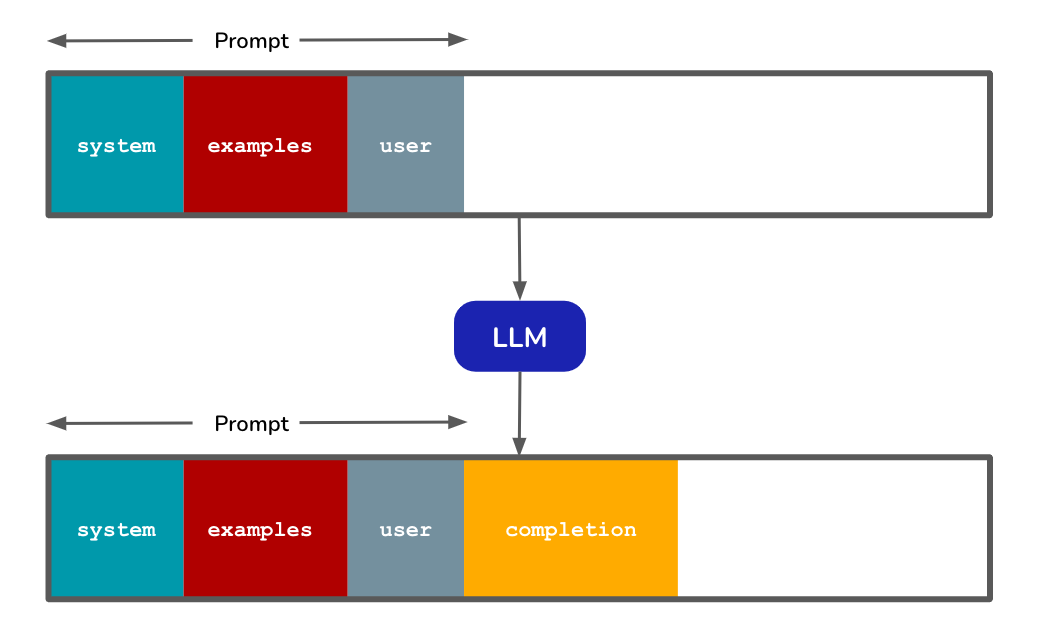
Zero-Shot prompting
Zero-shot prompting वह है जब आप एक भाषा मॉडल से किसी कार्य को करने के लिए कहते हैं बिना यह बताए कि कार्य कैसे किया जाना चाहिए। हम केवल एक स्पष्ट और वर्णनात्मक निर्देश पर निर्भर करते हैं।
एक पाठ हुक बनाने के लिए एक ज़ीरो-शॉट प्रॉम्प्ट इस प्रकार होगा:
import config
API_KEY =  config.open_api_key
from openai import AzureOpenAI
model_name = "gpt-4o"
system_message = """Create a list of 3-5 engaging lesson hooks for a lesson keeping in mind the grade of the students.
The hooks should be designed to capture students' attention and interest at the start of the lesson.
Consider the developmental needs and interests of students at this age when crafting the hooks."""
user_prompt = "Create a lesson hook for a lesson on newton's third law of motion for grade 8 students"
from openai import OpenAI

client = OpenAI(api_key = API_KEY)

response = client.chat.completions.create(
    model=model_name,  # Or another suitable model
    messages=[
        {"role": "system", "content":system_message},
        {"role": "user", "content": user_prompt}
    ]
)
print(response.choices[0].message.content)
Here are a few engaging lesson hooks specifically designed to capture the attention of grade 8 students as they learn about Newton's Third Law of Motion:

1. **Balloon Rocket Challenge**: Begin the lesson by showing a briefly inflated balloon. Secure the balloon to a straw that threads through a piece of string stretched between two points. Release the balloon and watch it zip along the string. Ask the students what they think is happening and how it relates to Newton's Third Law: "For every action, there is an equal and opposite reaction." Encourage predictions and immediate engagement with the law's concept in action.

2. **Interactive Tug-of-War**: Divide the students into two groups and have a fun, quick tug-of-war contest using a sturdy rope. Before they begin, ask them to think about what will happen when they pull, and why both teams feel a force acting on them. After the game, discuss how Newton's Third Law applies—the force each team exerts is met with an equal and opposite force from the other team.

3. **Water Rocket Experiment**: Demonstrate a small water rocket launch outdoors. As you prepare to launch the water rocket using a bike pump or hand pump, have students predict what will happen and why. Once launched, discuss how the expulsion of water results in the rocket moving in the opposite direction due to Newton's Third Law. This visual and dynamic demonstration will help solidify the law's principles.

4. **Mystery Box with Pulleys**: Prepare a mystery box with a pulley system on top, and without revealing too much, ask a volunteer to help pull one end of a string. As the string is pulled, the opposite reaction occurs, lifting a weight or revealing what's inside the box. Capture their curiosity and enthusiasm as they try to figure out how the law of motion explains the system.

5. **Synchronized Skaters Video**: Show a short, captivating video clip of synchronized skaters or dancers pushing off one another to move in opposite directions. Ask the students to think about what forces are at play and how Newton's Third Law is manifested in real life. This activity connects the concept to something familiar and visually striking, setting the stage for a more detailed exploration.

These hooks are developmentally appropriate for grade 8 students, incorporating curiosity, challenge, and real-life applications to encourage engagement with the physical principles of motion.
यह बिल्कुल भी बुरा आउटपुट नहीं है। हम नतीजों को बेहतर बनाने के लिए temperature और Top-k जैसे पैरामीटर्स को और बदल सकते हैं।
प्Prompt parameters
Maximum tokens
max_tokens पैरामीटर का मतलब है कि चैट पूरी होने पर ज़्यादा से ज़्यादा कितने टोकन जेनरेट किए जा सकते हैं। इस पैरामीटर से, हम आउटपुट की लंबाई को इस तरह बदल सकते हैं कि टोकन लिमिट तक पहुँचने पर जेनरेशन (कभी-कभी अचानक) रुक जाए।
response = client.chat.completions.create(
    model=model_name,
    messages=[
        {"role": "system", "content": system_message},
        {"role": "user", "content": user_prompt}
    ],
    max_tokens=256
)
print(response.choices[0].message.content)
1. **Balloon Rocket Demonstration:** Start the lesson by setting up a simple balloon rocket. Inflate a balloon and attach it to a straw that is threaded onto a long piece of string stretched between two points in the classroom. Release the balloon and let it zoom across the string. Ask students why the balloon moved in the opposite direction of the released air. This visual and interactive demo is a great way to introduce Newton's Third Law: "For every action, there is an equal and opposite reaction."

2. **Pop Culture Connection:** Kick off the lesson by showing a short clip from a popular superhero movie that features an epic battle scene. Focus on a moment when the hero uses their powers to send enemies flying backward. Pause the clip and challenge the students to connect these cinematic moments with real physics by discussing how Newton's Third Law is illustrated in these dramatic, exaggerated scenes.

3. **Tug-of-War Surprise:** Organize a quick classroom tug-of-war competition with a twist. Secretly have one side let go after a short pull. Once they fall back or the other side falls, discuss what happened in terms of both forces at play during the tug-of-war, using it as a metaphor for understanding action and reaction forces.

4. **Virtual Weigh Station
Temperature
यह पैरामीटर प्रतिक्रिया में विविधता को नियंत्रित करता है। उच्च temperature का उपयोग करने से संभावित रूप से कम संभावना (probability) वाले टोकन का चयन होता है। उच्च temperature के साथ, हम मॉडल को एक ही प्रॉम्प्ट के लिए कई पूर्णताएँ बनाने के लिए प्रेरित कर सकते हैं।
उच्च temperature के साथ, केवल उच्चतम संभावना वाले टोकन चुने जाते हैं, इसलिए कई पूर्णताएँ समान प्रतिक्रिया लौटानी चाहिए। यह हमारे फीचर के लिए बहुत उपयोगी नहीं है। हम शिक्षकों को चुनने के लिए कई विकल्प देना चाहते हैं।
response = client.chat.completions.create(
    model=model_name,
    messages=[
        {"role": "system", "content": system_message},
        {"role": "user", "content": user_prompt}
    ],
    n=2,# This will ask the model to present two choices for completion so that the teacher has many options to choose from
    temperature=0
)
print(response.choices[0].message.content)
print('--------------')
print(response.choices[1].message.content)
1. **Balloon Rocket Race**: Begin the lesson by setting up a simple balloon rocket race. Attach a string across the classroom and thread a straw through it. Inflate a balloon without tying it, tape it to the straw, and let it go. As the balloon propels itself along the string, ask students to observe and predict what is happening. This visual and interactive demonstration will pique their curiosity about the forces at play, leading into a discussion on Newton's Third Law of Motion.

2. **Action-Reaction Tug of War**: Organize a quick tug-of-war game using a rope. Divide the class into two teams and have them pull against each other. After a few rounds, pause the game and ask students to reflect on what they felt and observed. Use their experiences to introduce the concept of action and reaction forces, setting the stage for a deeper exploration of Newton's Third Law.

3. **Mystery Box Challenge**: Present the class with a sealed "mystery box" that contains a small object. Tell students that the box will move when they push it, but the object inside will react in a surprising way. Allow them to hypothesize what might happen when the box is pushed and then demonstrate it. This will spark their curiosity and lead into a discussion about how forces interact according to Newton's Third Law.

4. **Interactive Video Clip**: Show a short, engaging video clip of a real-world application of Newton's Third Law, such as a rocket launch or a skateboarder performing tricks. Pause the video at key moments and ask students to identify the action and reaction forces they observe. This visual and relatable example will help them connect the concept to real-life scenarios.

5. **Human Spring Experiment**: Have students pair up and stand facing each other with their hands pressed together. Ask them to push against each other's hands and observe what happens. Encourage them to describe the sensations and movements they experience. This simple activity will help them physically feel the action-reaction forces, making the concept of Newton's Third Law more tangible and memorable.
--------------
1. **Balloon Rocket Race**: Begin the lesson by setting up a simple balloon rocket race. Attach a string across the classroom and thread a straw through it. Inflate a balloon without tying it, tape it to the straw, and let it go. As the balloon propels itself along the string, ask students to observe and predict what is happening. This visual and interactive demonstration will pique their curiosity about the forces at play, leading into a discussion on Newton's Third Law of Motion.

2. **Action-Reaction Tug of War**: Organize a quick tug-of-war game using a rope, but with a twist. Have two students of similar strength pull on the rope while standing on skateboards or rolling chairs. As they pull, they will move towards each other, demonstrating the action-reaction forces. Ask the class to describe what they see and how it relates to forces acting in pairs, setting the stage for a deeper exploration of Newton's Third Law.

3. **Mystery Box Challenge**: Present the class with a sealed box labeled "Mystery Forces Inside!" and ask them to hypothesize what could be inside that demonstrates Newton's Third Law. After a brief discussion, reveal the contents: a set of magnets, a toy car, and a spring. Use these items to create simple demonstrations of action and reaction forces, engaging students' curiosity and encouraging them to think critically about the law in question.

4. **Video Clip of a Space Launch**: Show a short, exciting video clip of a rocket launch. As the rocket takes off, pause the video and ask students to discuss what they think is happening in terms of forces. Use this as a springboard to introduce the concept of action and reaction, explaining how the rocket's engines push down on the ground, and the ground pushes the rocket upwards, illustrating Newton's Third Law.

5. **Interactive Simulation**: Use an online simulation tool where students can manipulate variables to see how different forces interact. Start the lesson by allowing them to experiment with the simulation, such as launching virtual objects or colliding them. Encourage them to make observations and ask questions about the forces they see in action, leading into a discussion on how these observations relate to Newton's Third Law of Motion.
हम देख सकते हैं कि प्रतिक्रियाओं के बीच बहुत अधिक भिन्नता नहीं है। दूसरी ओर, temperature बढ़ाने से आउटपुट में विविधता बढ़ जाती है।
response = client.chat.completions.create(
    model=model_name,
    messages=[
        {"role": "system", "content": system_message},
        {"role": "user", "content": user_prompt}
    ],
    n=2,# This will ask the model to present two choices for completion so that the teacher has many options to choose from
    temperature=1
)
print(response.choices[0].message.content)
print('--------------')
print(response.choices[1].message.content)
Certainly! Engaging middle school students, particularly those in grade 8, requires a dynamic and interactive approach that stimulates curiosity and connects with their everyday experiences. Here are a few captivating lesson hooks for introducing Newton's Third Law of Motion:

1. **Balloon Rocket Challenge:**
   Begin the class by challenging students to create a simple balloon rocket. Provide each group with a balloon, string, a drinking straw, and tape. Have them tape the straw to the blown-up (but not tied) balloon, thread the string through the straw, and let the balloon go. As they watch the balloon zip along the string, prompt them to think about what pushes the balloon forward and ask how it relates to Newton's Third Law.

2. **Push-Pull Tug-of-War:**
   Set up a quick tug-of-war game using a rope with equal teams on either side. As they pull, encourage students to observe what happens when they pull and what they feel. After a brief match, discuss how despite the teams exerting force against each other, they both remain in place, leading into an exploration of the action-reaction principle.

3. **Mystery Box Experiment:**
   Present the students with a closed, lightweight box. Inside, place balls of different weights on opposite sides connected by a spring. Shake the box lightly so they hear and feel the movement inside. Ask them to hypothesize what might be happening inside the box to make it behave in such a way. After some guesses, reveal the setup and link it to Newton's concept of action and reaction forces.

4. **Interactive Video Clip:**
   Start the lesson with a short, intriguing video clip showing dramatic and unexpected results of everyday actions, such as a skateboarder pushing off a wall or a rocket launch. Pause the video at relevant moments to ask students what they think causes the movements they see, then lead into a discussion about Newton's Third Law.

5. **Real-Life Action-Reaction Scenarios:**
   Pose a series of quick, relatable scenario questions like "What happens when you jump off a small boat onto a dock?" or "Why does a swimming fish move forward?" Have students discuss their thoughts in pairs, then use their observations to introduce the concept of equal and opposite forces.

Each of these hooks uses hands-on, relatable, or multimedia methods to engage students' imaginations and spark interest in the fundamental physics that governs their world.
--------------
1. **Rocket Balloon Launch:** Begin the lesson by inflating a balloon and holding the mouth closed. Ask the students to predict what will happen when you release it. Let the balloon go and observe its flight across the room. Engage the students by asking, "Why does the balloon shoot across the room when we let it go?" Use this demonstration to introduce the concept that for every action there is an equal and opposite reaction, a fun entry point into Newton's Third Law of Motion.

2. **Tug of War Challenge:** Organize a brief tug of war between two groups of students using a rope. After they’ve exerted their energy, pose the question, "What forces were at play here, and why didn’t one team fly backwards the moment they started pulling?" This physical activity can stimulate discussion on action and reaction forces, relevant to Newton’s Third Law.

3. **Mystery Box Push/Pull:** Before the lesson, place a mysterious box at the front of the class. Challenge students to move the box without directly touching it. Provide options like blowing on it through a straw, using a fan, or using a second object to push it. After they’ve tried different methods, discuss the unseen forces at play and relate it back to Newton's Third Law.

4. **Egg Drop Surprise:** Start by holding an egg and dropping it into a small glass of water with a plate and cardboard tube balancing on top. Ask students to explain why the egg lands in the water instead of breaking elsewhere. Use this engaging demonstration to introduce how balanced and unbalanced forces result in actions and reactions.

5. **Interactive Video Clip:** Show a short, exciting video of a space rocket launch, focusing on the exhaust of gases and the upward motion of the rocket. Pause the video at strategic moments and ask the students, "What exactly is propelling the rocket upwards?" Use this captivating imagery to hook students into understanding Newton's Third Law in the context of rocketry and space exploration.
ये परिणाम अच्छे हैं लेकिन प्रतिक्रियाएँ अभी भी समान हैं।
Top-p
Top-p, जिसे nucleus sampling भी कहा जाता है, एक रणनीति है जो मॉडल आउटपुट की विविधता को नियंत्रित करती है (जैसे temperature)। उच्च p (जैसे 0.95) अधिक रचनात्मक, विविध आउटपुट के लिए है।
- निम्न p (जैसे 0.8): अधिक केंद्रित, निर्धारणात्मक प्रतिक्रियाएँ।
- उच्च p (जैसे 0.95): अधिक रचनात्मक, विविध आउटपुट।
यह पैरामीटर अक्सर temperature के साथ उपयोग किया जाता है ताकि उत्पन्न पाठ में सटीकता और रचनात्मकता के बीच संतुलन बनाया जा सके।
response = client.chat.completions.create(
    model=model_name,
    messages=[
        {"role": "system", "content": system_message},
        {"role": "user", "content": user_prompt}
    ],
    n=2,# This will ask the model to present two choices for completion so that the teacher has many options to choose from
    temperature=1,
    top_p=0.9
)
print(response.choices[0].message.content)
print('--------------')
print(response.choices[1].message.content)
1. **Balloon Rocket Race**: Begin the lesson by setting up a fun and interactive balloon rocket race. Attach strings across the classroom and thread a straw through each string. Inflate balloons without tying them off and tape them to the straws. Let the balloons go simultaneously and watch them zoom across the room. Ask the students to observe what happens and why. This demonstration will immediately capture their attention and provide a tangible example of Newton's Third Law: for every action, there's an equal and opposite reaction.

2. **Virtual Reality Experience**: If available, use a virtual reality setup to give students a first-person experience of an astronaut in space. Simulate scenarios where they push against the side of a spaceship and see themselves float in the opposite direction. After the experience, prompt students to discuss what they felt and how it relates to Newton's Third Law.

3. **Magic Trick Teaser**: Perform a simple "magic" trick where you sit on a swivel chair and use a heavy book to demonstrate motion. Hold the book and spin the chair in one direction while releasing the book in the opposite direction. Ask the students to predict what will happen to the chair when the book is released. Use their curiosity to delve into the concept that actions have equal and opposite reactions.

4. **Interactive Video Clip**: Start with a short, engaging video clip of different real-world examples of Newton's Third Law, such as a skateboarder pushing off a wall, a bird taking flight, or a rocket launch. Pause the video at key moments to ask students to predict what will happen next or to explain the observed reaction. This visual introduction sets the stage for an exciting and relatable exploration of the topic.

5. **Human Tug-of-War**: Engage students in a quick game of tug-of-war using a rope in the classroom. Have students form teams and pull the rope from opposite ends. As they exert force, ask them to notice what happens and how they feel the opposing force. This physical activity will not only energize them but also illustrate the concept of equal and opposite forces in a memorable way.
--------------
1. **Balloon Rocket Challenge:** Begin the class by showing a simple balloon rocket demonstration. Inflate a balloon, attach it to a straw on a string track, and release it. As the balloon propels along the string, ask students what they think is happening. This visual and interactive setup will spark curiosity and lay the groundwork for discussing action and reaction forces.

2. **Real-Life Tug-of-War:** Organize a quick, friendly tug-of-war contest in the classroom or outside. Pair students up and have them pull on a rope. After the activity, prompt them to think about how their pulling force is met with an equal force from their opponent, leading to a discussion about Newton's Third Law.

3. **Epic Fail Videos:** Start the lesson with a compilation of funny and relatable 'epic fail' videos where people experience action-reaction scenarios, such as slipping or falling. After watching, challenge students to explain the physics behind these mishaps using Newton's Third Law.

4. **Mystery Box Experiment:** Present students with a "mystery box" filled with various objects that react to forces (e.g., a bouncy ball, a spring, a rubber band). Have them make predictions about what will happen when they apply force to these objects and then test their hypotheses. This hands-on approach encourages inquiry and ties directly into the law of motion.

5. **Virtual Reality Experience:** If resources permit, use a virtual reality headset to take students on a simulated space journey. In zero gravity, demonstrate how astronauts push against surfaces to move, illustrating Newton's Third Law in an engaging and futuristic context. Afterward, discuss how these experiences are connected to the law of motion.
हम देख सकते हैं कि प्रतिक्रियाओं के बीच बहुत अधिक भिन्नता नहीं है। दूसरी ओर, temperature बढ़ाने से आउटपुट में विविधता बढ़ जाती है।
Penalties
प्रॉम्प्ट करने में आप दो तरह की penalty इस्तेमाल कर सकते हैं: Presence Penalty और Frequency penalty। दोनों पैरामीटर जेनरेट किए गए टेक्स्ट में दोहराव और नएपन को कंट्रोल करने में मदद करते हैं: 1. Presence penalty - पहले से मौजूद टोकन पर penalty लगाकर मॉडल को नए टॉपिक या शब्द लाने के लिए बढ़ावा देता है। - ज़्यादा वैल्यू का मतलब है ज़्यादा अलग-अलग तरह का कंटेंट, कम दोहराव। - उदाहरण: यह तब काम आता है जब आप एक ही आइडिया पर टिके बिना क्रिएटिव ब्रेनस्टॉर्मिंग करना चाहते हैं। 2. Frequency penalty - एक ही शब्द या फ्रेज़ को कई बार दोहराने की संभावना कम करता है। - ज़्यादा वैल्यू का मतलब है कम फालतूपन, ज़्यादा छोटे जवाब। - उदाहरण: समराइज़ेशन या साफ़, बिना दोहराव वाला टेक्स्ट बनाने में मददगार। हम टॉपिक में अलग-अलग तरह के लिए presence_penalty का इस्तेमाल कर सकते हैं जबकि frequency_penalty शब्द-लेवल दोहराव को कम कर सकती है।
response = client.chat.completions.create(
    model=model_name,
    messages=[
        {"role": "system", "content": system_message},
        {"role": "user", "content": user_prompt}
    ],
    n=2,# This will ask the model to present two choices for completion so that the teacher has many options to choose from
    temperature=0.7,
    presence_penalty=0.8
)
print(response.choices[0].message.content)
print('--------------')
print(response.choices[1].message.content)
1. **Balloon Rocket Race**: Begin the lesson by setting up a simple balloon rocket race. Inflate several balloons and let them loose across the classroom, demonstrating how they zip around when released. Ask the students to observe what happens and brainstorm why the balloons move in the opposite direction of the air being expelled. This hands-on activity will introduce the concept of action and reaction forces in an engaging way.

2. **Action-Reaction Role Play**: Start the class with a quick role-play exercise. Pair up students and have them push against each other’s hands while standing face-to-face. Ask them to describe the forces they feel and discuss how they're both exerting and experiencing equal and opposite forces. This physical demonstration will help them visualize Newton's third law in action.

3. **Video Clip from Real Life**: Show a short, exciting video clip of a rocket launch or a skateboarder performing a trick. Pause at key moments to ask students what's happening in terms of forces. How is the rocket moving upwards, or how does a skateboarder propel themselves? This visual will capture their interest and set the stage for exploring how action and reaction forces work.

4. **Mystery Box Challenge**: Present the class with a "mystery box" containing various items that exemplify Newton's third law (e.g., a rubber band, a small toy car, a bouncy ball). Have students predict how the items demonstrate action and reaction forces. After predictions, reveal the items one by one, conducting mini-experiments to see the law in action.

5. **Interactive Simulation**: Use an interactive computer simulation or physics app that visually demonstrates Newton's third law. Allow students to manipulate variables like mass and force to see how changes affect motion. This tech-based approach can captivate tech-savvy eighth graders and offer a visual representation of abstract concepts.
--------------
1. **Balloon Rocket Race**: Begin the lesson by setting up a simple balloon rocket race. Inflate several balloons and let them loose across the classroom, demonstrating how they zip around when released. Ask the students to observe what happens and brainstorm why the balloons move in the opposite direction of the air being expelled. This hands-on activity will introduce the concept of action and reaction forces in an engaging way.

2. **Action-Reaction Role Play**: Start the class with a quick role-play exercise. Pair up students and have them push against each other’s hands while standing face-to-face. Ask them to describe the forces they feel and discuss how they're both exerting and experiencing equal and opposite forces. This physical demonstration will help them visualize Newton's third law in action.

3. **Video Clip from Real Life**: Show a short, exciting video clip of a rocket launch or a skateboarder performing a trick. Pause at key moments to ask students what's happening in terms of forces. How is the rocket moving upwards, or how does a skateboarder propel themselves? This visual will capture their interest and set the stage for exploring how action and reaction forces work.

4. **Mystery Box Challenge**: Present the class with a "mystery box" containing various items that exemplify Newton's third law (e.g., a rubber band, a small toy car, a bouncy ball). Have students predict how the items demonstrate action and reaction forces. After predictions, reveal the items one by one, conducting mini-experiments to see the law in action.

5. **Interactive Simulation**: Use an interactive computer simulation or physics app that visually demonstrates Newton's third law. Allow students to manipulate variables like mass and force to see how changes affect motion. This tech-based approach can captivate tech-savvy eighth graders and offer a visual representation of abstract concepts.
Few-shot prompting
जबकि सिस्टम संदेशों(system prompt )का उपयोग LLMs के व्यवहार को नियंत्रित करने के लिए किया जा सकता है, यह तब कठिन हो जाता है जब हम अपेक्षा करते हैं कि आउटपुट एक विशिष्ट प्रारूप का पालन करेगा (जैसे, JSON)। ऐसी स्थितियों में, कुछ उदाहरण बहुत दूर तक LLM के व्यवहार को निर्दिष्ट करने में मदद करते हैं (दिखाएँ, न कि बताएं). यह तकनीक "few-shot prompting" कहलाती है। (यदि केवल एक उदाहरण प्रदान किया जाता है, तो यह "one-shot prompting" बन जाता है)।
system_message = """Create a list of 3-5 engaging lesson hooks for a lesson keeping in mind the grade of the students.
The hooks should be designed to capture students' attention and interest at the start of the lesson.
Consider the developmental needs and interests of students at this age when crafting the hooks."""
messages = [
    {"role": "system", "content": system_message},

    {"role": "user", "content": "Create a lesson hook on States of Matter for grade 5"},
    {"role": "assistant", "content": """Bring in a few different objects (e.g., ice cube, piece of metal, balloon) and ask students to describe their properties. Then reveal that these objects are all made of the same basic building blocks - atoms and molecules - just in different states."""},

    {"role": "user", "content": "Create a lesson hook on Multiplication for grade 3"},
    {"role": "assistant", "content": """Tell a simple story about going to the store and buying multiple items of the same kind (e.g., 3 bags of apples with 4 apples in each bag). Have students act it out with manipulatives to discover multiplication."""},

    {"role": "user", "content": "Create a lesson hook on civil war for grade 7"},
    {"role": "assistant", "content": """Hook: Read contrasting first-hand accounts from soldiers on opposite sides of a major battle. Discuss how perspectives differ."""},

    {"role": "user", "content": "Create a lesson hook on Photosynthesis for grade 7"},
    {"role": "assistant", "content": """The Incredible Shrinking Student: Tell students to imagine they are shrinking down to the size of a molecule to take a journey inside a leaf. Use this to introduce the structures involved in photosynthesis."""},

    {"role": "user", "content": "Create a lesson hook on Photosynthesis for grade 7"},
    {"role": "assistant", "content": """Divide the class into teams, each representing a part of the photosynthesis process. Have them race to complete the process in the correct order."""},

    {"role": "user", "content": "Create a lesson hook on Anatomy for grade 6"},
    {"role": "assistant", "content": """"Interview a Body Part": Assign each student a specific body part or system. Have them create interview questions and then act out an interview with their assigned part, discussing its functions, challenges, and fun facts."""},

    {"role": "user", "content": "Create a lesson hook on Ancient Civilizations for grade 7"},
    {"role": "assistant", "content": """""The Lost Civilization": Students are archaeologists who have discovered a long-lost civilization.
        As they uncover artifacts and decipher ancient texts, they learn about the culture, achievements, and eventual decline of this mysterious society, inspiring a deep dive into ancient history.
        Question Hook: "Why do some societies thrive while others collapse? Is it simply a matter of luck, or are there underlying patterns?" This hook is ideal for a unit on the rise and fall of ancient civilizations.
        """
    },
    {"role": "user", "content": user_prompt}
]
response = client.chat.completions.create(
    model=model_name,
    messages=messages,
    temperature=0.5
)
print(response.choices[0].message.content)
"Balloon Rocket Challenge": Begin the lesson by challenging students to create a simple balloon rocket. Provide each group with a balloon, a piece of string, and a straw. Have them thread the string through the straw and tape the inflated balloon to the straw without letting any air out. When they release the balloon, it will propel itself along the string. Use this activity to introduce Newton's Third Law of Motion by discussing how the air rushing out of the balloon creates an equal and opposite reaction, propelling the balloon forward. This hands-on activity will capture their interest and provide a tangible example of the law in action.
Few-shot prompting की प्रदर्शन क्षमता प्रदान किए गए उदाहरणों और कार्य के स्वभाव पर निर्भर करती है। उदाहरण के लिए, क्योंकि हमने हर उदाहरण में केवल एक हुक प्रदान किया, मॉडल ने एक ही उदाहरण के साथ प्रतिक्रिया दी, जबकि हमने 3-5 उदाहरणों के लिए अनुरोध किया। इस कार्य में, few-shot ज़ीरो-शॉट से महत्वपूर्ण रूप से बेहतर नहीं है। बेहतर उदाहरण बेहतर परिणामों की ओर ले जा सकते हैं।
उदाहरणों का उपयोग करके, आप LLM की प्रतिक्रिया को नए दिशाओं में निर्देशित कर सकते हैं। जबकि हम जितने अधिक उदाहरणों का उपयोग कर सकते हैं, प्रत्येक नए उदाहरण के साथ हम API कॉल प्रति टोकन खपत बढ़ा रहे हैं, जो उच्च लागत का कारण बनता है। उदाहरणों की संख्या को प्रदर्शन पर प्रभाव की जांच करते हुए धीरे-धीरे जोड़ने और हटाने के द्वारा अनुकूलित किया जाना चाहिए।
Chain-of-thought prompting
Chain-of-Thought prompting का उपयोग मॉडल की प्रतिक्रिया उत्पन्न करने की प्रक्रिया को मार्गदर्शित करने के लिए किया जाता है, जिसमें संबंधित प्रॉम्प्ट या प्रश्नों की एक श्रृंखला होती है। एकल प्रॉम्प्ट के बजाय, CoT में कई आपस में जुड़े कदम होते हैं जो मॉडल के विचार प्रक्रिया को मार्गदर्शित करते हैं। प्रत्येक कदम श्रृंखला का "सोचने" की प्रक्रिया का प्रतिनिधित्व करता है जिसे हम मॉडल से पालन करने के लिए कहते हैं।
CoT प्रॉम्प्ट को few-shot उदाहरणों के साथ बढ़ाया जा सकता है, ताकि प्रॉम्प्ट मॉडल की तर्क शक्ति को मार्गदर्शित करे जबकि उदाहरण अपेक्षित आउटपुट को मार्गदर्शित करते हैं।
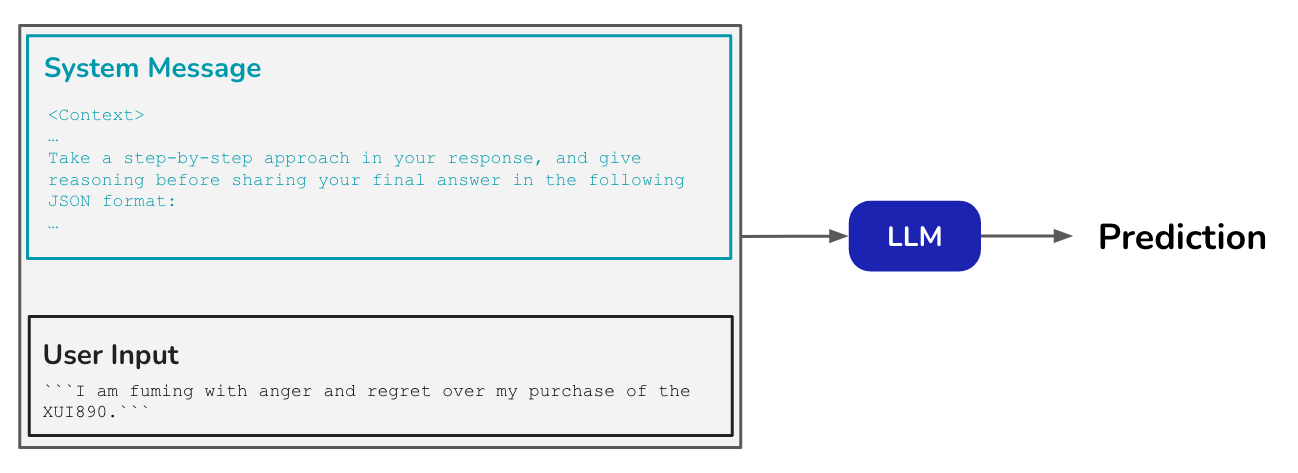
उदाहरण के लिए, एक पाठ हुक में निम्नलिखित गुण होने चाहिए।
1. ध्यान आकर्षित करना
2. जिज्ञासा उत्पन्न करना
3. प्रासंगिकता बनाना
4. उत्साह बढ़ाना
5. संबंध स्थापित करना
हम इन गुणों को LLM की प्रतिक्रिया में लागू करने के लिए एक श्रृंखला-के-चिंतन प्रॉम्प्ट का उपयोग कर सकते हैं।
cot_prompt = """
 Create an engaging lesson hooks for a topic for a given grade level classroom.
 The hooks should be designed to capture students' attention and interest at the start of the lesson.
 Consider the developmental needs and interests of students at this age when crafting the hooks.

Below are 5 steps you need to follow to craft the lesson hook. At each step, you should check if any rewriting of the hook is necessary.
If so, add or remove text to align with the step. At the end, you should give me a lesson hook that follows all the guidelines.
At each step, evaluate if the current core of the hook is effective.
If at any point you feel like the current hook is ineffective, you should restart crafting the hook with a new core idea.

Step 1: Identify the lesson topic and key concepts
- What is the main subject or theme of the lesson?
- What are the most important ideas or skills students should learn?

Step 2: Consider the students' interests, experiences, and prior knowledge
- What do the students already know about this topic?
- What aspects of the topic might the students find most interesting or relatable to their lives?
- What current events, popular culture references, or real-world examples could help connect the lesson to the students' experiences?

Step 3: Brainstorm attention-grabbing opening techniques
- Could you start with a surprising fact, statistic, or statement related to the topic?
- Is there a thought-provoking question you could pose to the students?
- Could you present a mysterious or intriguing scenario that ties into the lesson?
- Would a short, engaging story or anecdote help capture the students' attention?

Step 4: Incorporate elements of curiosity and relevance
- How can you frame the hook to make students curious to learn more about the topic?
- What aspects of the hook will make the lesson feel relevant and meaningful to the students' lives or interests?
- Could you hint at an exciting activity, demonstration, or revelation to come later in the lesson?

At the end, evaluate all the ideas you have created and finally choose a single lesson hook that's best suited.
Explain why it's the best lesson hook and then write the best lesson hook.
"""
user_prompt = "Create a lesson hook for a lesson on newton's third law of motion for grade 8 students"

messages = [
    {"role": "system", "content": cot_prompt},
    {"role": "user", "content": user_prompt}
]
response = client.chat.completions.create(
    model=model_name,
    messages=messages,
    temperature=0.5
)
print(response.choices[0].message.content)
Step 1: Identify the lesson topic and key concepts
- The main subject of the lesson is Newton's Third Law of Motion.
- The most important idea is understanding that for every action, there is an equal and opposite reaction.

Step 2: Consider the students' interests, experiences, and prior knowledge
- Students may have some basic understanding of forces and motion from previous science lessons.
- They might find it interesting how Newton's Third Law applies to everyday activities, such as sports or riding a skateboard.
- Current events like space exploration or popular culture references like superhero movies could help connect the lesson to students' experiences.

Step 3: Brainstorm attention-grabbing opening techniques
- Start with a surprising fact: "Did you know that every time you take a step, you're actually pushing the Earth away from you?"
- Pose a thought-provoking question: "What do you think happens when a superhero punches a villain with all their might?"
- Present a mysterious scenario: "Imagine you're floating in space and you push against the wall of your spaceship. What do you think will happen to you?"
- Tell an engaging story: "Once upon a time, a group of astronauts found themselves in a zero-gravity environment where every tiny movement sent them spinning in unexpected directions..."

Step 4: Incorporate elements of curiosity and relevance
- Frame the hook to make students curious: "Today, we're going to explore how every action we take has a surprising reaction, and you'll get to see it in action!"
- Make the lesson relevant: "Understanding this law can help you improve in sports, solve puzzles, and even understand how rockets launch into space!"
- Hint at an exciting activity: "By the end of the lesson, you'll get to create your own mini rocket and see Newton's Third Law in action!"

Final Evaluation and Best Lesson Hook:

The best lesson hook combines an engaging scenario with a relatable and exciting activity. We will use the mysterious scenario and tie it to an exciting activity to capture students' interest:

"Imagine you're floating in space and you push against the wall of your spaceship. What do you think will happen to you? Today, we're diving into the world of Newton's Third Law of Motion, where you'll discover how every action you take has a surprising reaction. By the end of the lesson, you'll even get to create your own mini rocket and watch it launch, seeing this law in action firsthand!"

This hook is effective because it captures students' imaginations with a space scenario, relates to their interests in science and exploration, and promises an engaging hands-on activity.
हम देख सकते हैं कि प्रतिक्रियाओं के बीच बहुत अधिक भिन्नता नहीं है। दूसरी ओर, temperature बढ़ाने से आउटपुट में विविधता बढ़ जाती है।
Rephrase and respond
Rephrase & Respond विधि में, हम LLM से मूल उपयोगकर्ता प्रश्न को एक ऐसे प्रारूप में पुनः व्यक्त करने के लिए कहते हैं जो इसे बेहतर उत्तर देने में सक्षम बनाएगा।
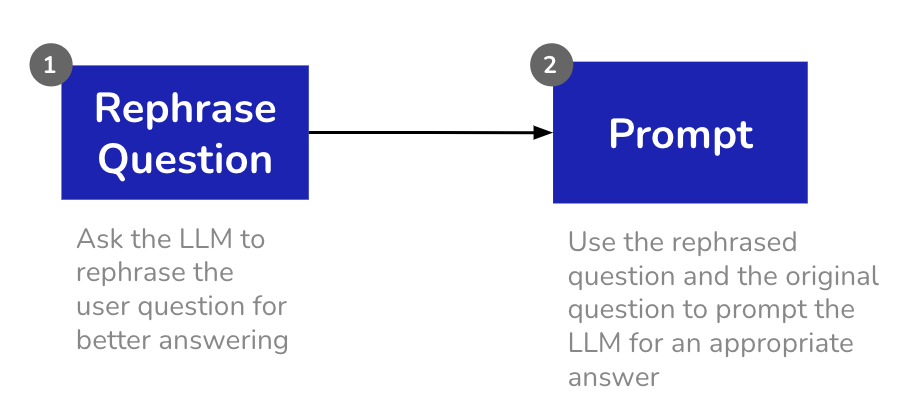 आइए इस विधि का उपयोग करके दस प्रश्न बनाते हैं।
system_message = """Rephrase the question for clarity, then create 10 questions for testing the knowledge for 8 grade students."""
user_prompt = "Example: 3x + 5 = 17"
messages = [
    {"role": "system", "content": system_message},
    {"role": "user", "content": user_prompt}
]
response = client.chat.completions.create(model="gpt-4o", messages=messages)
print(response.choices[0].message.content)
Please solve the linear equation: 3x + 5 = 17.

Questions for 8th-grade students:

1. What is the first step to isolate the variable x in the equation 3x + 5 = 17?
2. After subtracting 5 from both sides of the equation 3x + 5 = 17, what is the resulting equation?
3. Once you have the equation 3x = 12, what should you do next to solve for x?
4. How would you check your solution once you find the value of x?
5. If 3x + 5 = 17, what does x equal?
6. What operation is used to eliminate the constant '5' from the left side of the equation 3x + 5 = 17?
7. In the equation 3x + 5 = 17, identify the coefficient of x.
8. What is the result of dividing both sides of the equation 3x = 12 by 3?
9. How would the equation change if the constant term (+5) on the left side were a -5 instead?
10. Solve the equation 3x + 5 = 17 and write your answer as a fraction, if necessary.
LLM as a judge
इस विधि में, हम एक अन्य LLM का उपयोग करते हैं ताकि मूल कार्य में उपयोग किए गए LLM के प्रदर्शन का मूल्यांकन किया जा सके। LLMs का उपयोग करके आउटपुट का मूल्यांकन करना एक सामान्य प्रक्रिया है, क्योंकि हमें मानव बुनियादी रेखाएँ (human baselines) (जो महंगी होती हैं) की आवश्यकता नहीं होती है। मूल्यांकन के लिए उपयोग किए जाने वाले LLM के लिए सिस्टम संदेश ों(system prompt) में स्पष्ट रूप से मूल्यांकन के लिए उपयोग किए जाने वाले मानदंडों को परिभाषित करना आवश्यक है।
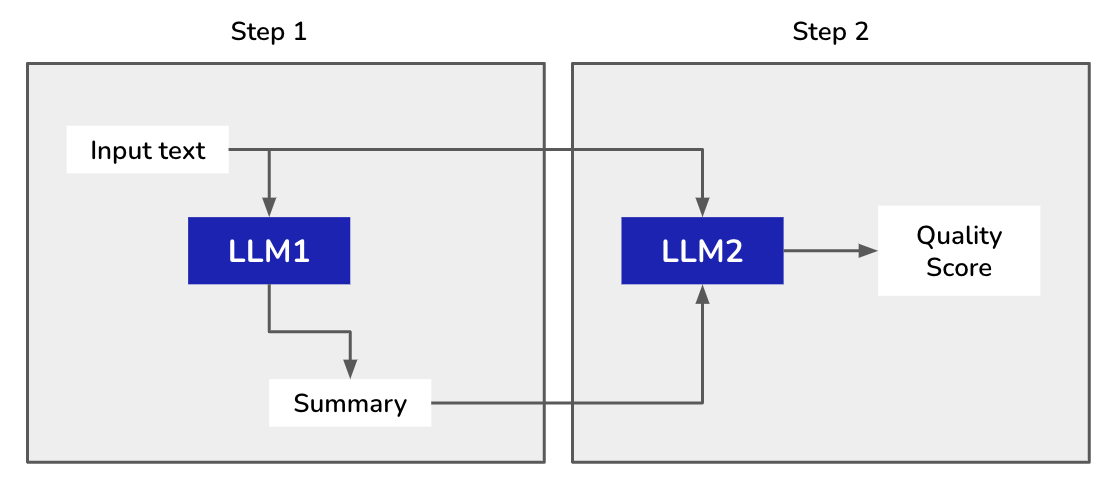 आइए पहले एक क्विज़ प्रश्न बनाते हैं।
system_message = """Create 1 question for testing the knowledge for 8 grade students."""
user_prompt = "Example question: Solve 3x + 5 = 17 for x"
messages = [
    {"role": "system", "content": system_message},
    {"role": "user", "content": user_prompt}
]
response = client.chat.completions.create(model="gpt-4o", messages=messages)
print(response.choices[0].message.content)
Sure! Here's a question suitable for testing the knowledge of an 8th-grade student:

Question: Simplify the expression: 4(2x - 3) + 6. What is the value of x when the expression equals 10?

Please provide your answer in a step-by-step manner.
आइए LLM का उपयोग करके प्रश्न की कठिनाई का मूल्यांकन करें।
RUBRIC = """
Rate K-12 math question difficulty for the specified grade (1–5) using this rubric:
1 = Very easy: direct recall, single-step arithmetic, no transformations, simple numbers.
2 = Easy: single-step equation or direct substitution, minimal operations, small integers.
3 = Moderate: two-step equation (e.g., 2x - 7 = 9), combine like terms, inverse operations; may include fractions or negatives.
4 = Challenging: multi-step manipulation, parentheses, mixed operations, rational coefficients, uncommon forms; careful error traps.
5 = Hard: multi-step with nontrivial structure, nested reasoning, edge cases, unfamiliar forms, or extension beyond grade level.

Always consider grade alignment, cognitive load (number of steps), symbol density, and common error traps.
"""

evaluator_system_prompt = f"""
You are a precise K-12 math difficulty judge.
Follow this rubric strictly.
{RUBRIC}
"""
evaluator_user_prompt = """
    Question: {0}
    Grade Target: {1}
    Task: Evaluate difficulty using the rubric. Highlight the final answer.
""".format(response.choices[0].message.content, 8)

messages = [
    {"role": "system", "content": evaluator_system_prompt},
    {"role": "user", "content": evaluator_user_prompt}
]
response = client.chat.completions.create(model="gpt-4o", messages=messages)
print(response.choices[0].message.content)
This 8th-grade math question has a few components:

1. Simplifying the expression: 4(2x - 3) + 6.
2. Solving the equation: Set the simplified expression equal to 10 and solve for x.

Breaking it down:

- Simplifying the expression involves distributing the 4 into the terms inside the parentheses and then combining like terms.
- Solving the equation after simplifying requires setting the resultant expression to 10 and isolating x, possibly involving inverse operations.

Analysis based on the rubric:

- Multi-step: Distribute, combine terms, set equal to 10, solve.
- Mixed operations: Includes both distributing and solving equations.
- Rational process: Involves simplifying before solving for x.
- Careful error traps: Distribution and solving correctly.

Overall, this is challenging for an 8th grader but aligns with typical algebraic manipulation skills expected at this level.

**Difficulty Rating: 4 (Challenging)**
Self-consistency
Self-consistency में, हम एक ही प्रश्न के लिए कई उत्तर उत्पन्न करते हैं और उन उत्तरों में से सबसे अधिक बार दोहराए गए उत्तर को चुनते हैं। यह विशेष रूप से तथ्यात्मक और तर्क-भारी प्रश्नों के लिए मूल्यवान है।
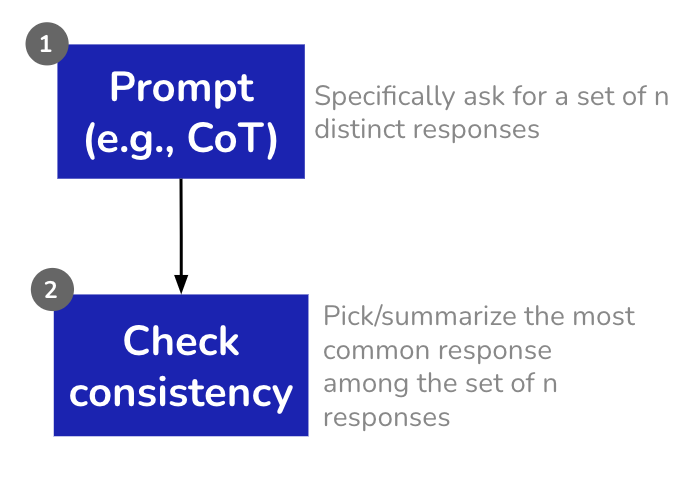 छात्र एक प्रश्न का उत्तर कई तरीकों से दे सकते हैं। हम इस विधि का उपयोग करके नमूना उत्तर बना सकते हैं और सत्यापित कर सकते हैं कि क्या वे समान समाधान तक पहुँचते हैं।
system_message = """Solve the equation using three different reasoning paths and pick the most common answer."""
user_prompt = "Solve: 2x - 7 = 9"
messages = [
    {"role": "system", "content": system_message},
    {"role": "user", "content": user_prompt}
]
response = client.chat.completions.create(model="gpt-4o", messages=messages, temperature=1, n=3)
for choice in response.choices:
    print(choice.message.content)
Let's solve the equation  2x - 7 = 9  using three different reasoning paths:

**Reasoning Path 1: Direct Algebraic Manipulation**

1. Start with the equation:
   2x - 7 = 9
2. Add 7 to both sides to get rid of the constant on the left side:
   2x - 7 + 7 = 9 + 7
   2x = 16
3. Divide both sides by 2 to solve for  x :
   x = 16/2
   x = 8

**Reasoning Path 2: Graphical Understanding**

1. Consider the equation  2x - 7 = 9  as two separate lines:  y = 2x - 7  and  y = 9 .
2. The solution to the equation is the x-coordinate of the intercept of the two lines.
3. For  y = 9 , draw a horizontal line at y = 9.
4. The line  y = 2x - 7  intersects the horizontal line when:
   2x - 7 = 9
   From our previous calculations, this occurs at  x = 8 .

**Reasoning Path 3: Substitution and Verification**

1. Guess a possible value for  x , say for example  x = 8 , and substitute it back into the original equation:
   2(8) - 7 = 16 - 7 = 9

2. Since the left-hand side equals the right-hand side of the equation,  x = 8  is a correct solution.

The most common answer from the three reasoning paths is:
x = 8
Let's solve the equation 2x - 7 = 9 using three different reasoning paths.

**Path 1: Algebraic Manipulation**

1. Start with the equation: 2x - 7 = 9.
2. Add 7 to both sides to isolate the term with x on one side of the equation:
   2x - 7 + 7 = 9 + 7
   Simplifying this gives:
   2x = 16
3. Divide both sides by 2 to solve for x:
   x = 16/2 = 8

**Path 2: Using Substitution to Check**

1. Assume x = 8, based on solving the equation.
2. Substitute x = 8 back into the original equation to check:
   2(8) - 7 = 16 - 7 = 9
   Since the left-hand side equals the right-hand side, x = 8 is indeed correct.

**Path 3: Visual Approach (Number Line or Logical Thinking)**

1. Recognize that 2x - 7 = 9 is asking for a value of x such that when it's doubled and reduced by 7, the result is 9.
2. Adding 7 to 9 gives the result before subtraction:
   9 + 7 = 16
3. The doubled value was 16, so dividing by 2 gives:
   x = 16/2 = 8

**Conclusion:**

All three reasoning paths lead to the same solution which is x = 8. Based on the consistency across methods, the most common and verified answer is x = 8.
Certainly! Let's solve the equation 2x - 7 = 9 using three different reasoning paths and see which solution is common among them.

### Reasoning Path 1: Algebraic Manipulation
1. Start with the equation: 2x - 7 = 9.
2. Add 7 to both sides to isolate the term with x:
   2x - 7 + 7 = 9 + 7 -> 2x = 16
3. Divide both sides by 2 to solve for x:
   2x/2 = 16/2 -> x = 8

### Reasoning Path 2: Inspection Method
1. Notice that the term 2x needs to equal 16 for the equation to hold, since 2x - 7 = 9 simplifies to 2x = 16.
2. Therefore, solve for x by dividing 16 by 2:
   x = 16/2 = 8

### Reasoning Path 3: Graphical Interpretation
1. Consider the equation as two functions: y = 2x - 7 and y = 9.
2. Their intersection point gives the solution for x.
3. Rearrange the equation 2x - 7 = 9 to 2x = 16.
4. Divide by 2:
   x = 8
5. Thus, the graphical intersection occurs at x = 8.

### Conclusion
All three reasoning paths consistently lead to the solution x = 8. Therefore, the most common and correct answer is x = 8.
Tree-of-thought
Tree-of-thought prompting एक श्रृंखला-के-चिंतन प्रॉम्प्टिंग का सामान्यीकरण है जहाँ मॉडल को कई तर्क पथ लेने के लिए प्रेरित किया जाता है। यह LLM को एक जानबूझकर तर्क मोड में लाने के लिए मजबूर करता है।
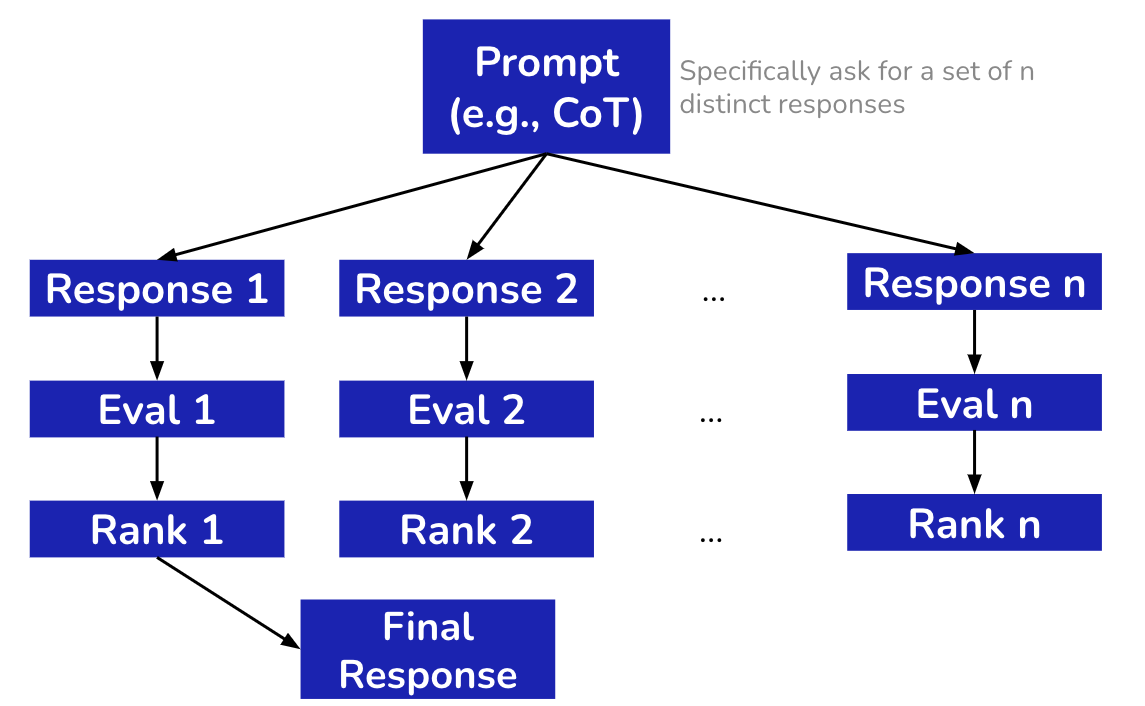 यह तकनीक जटिल कार्यों को संरचित चरणों में तोड़ती है, जिससे मॉडल को उत्तर देने से पहले योजना बनाने के लिए प्रोत्साहित किया जाता है। यह बहु-चरण तर्क के लिए आदर्श है जैसे कि क्विज़ निर्माण।
tree_prompt = """Plan the quiz step-by-step:
1. Identify topic and difficulty
2. Generate 5 MCQs
3. Provide correct answers
4. Ensure age-appropriateness
Finally, output the quiz in JSON format."""
user_prompt = "Generate a math quiz on solving two-step equations for grade 7."
messages = [
    {"role": "system", "content": tree_prompt},
    {"role": "user", "content": user_prompt}
]
response = client.chat.completions.create(model="gpt-4o", messages=messages)
print(response.choices[0].message.content)
Sure! Let's create a math quiz on solving two-step equations specifically for grade 7 students.

### Step 1: Identify Topic and Difficulty
- **Topic:** Solving Two-Step Equations
- **Difficulty:** Appropriate for Grade 7

### Step 2: Generate 5 Multiple Choice Questions (MCQs)

1. **Question 1:**
   Solve the equation:  3x + 4 = 19
   - A) 3
   - B) 5
   - C) 8
   - D) 6

2. **Question 2:**
   Solve the equation:  2x - 5 = 11
   - A) 8
   - B) 3
   - C) 6
   - D) 9

3. **Question 3:**
   Solve the equation:  4x + 7 = 31
   - A) 5
   - B) 6
   - C) 9
   - D) 8

4. **Question 4:**
   Solve the equation:  5x - 3 = 22
   - A) 4
   - B) 6
   - C) 5
   - D) 3

5. **Question 5:**
   Solve the equation:  7x + 2 = 23
   - A) 4
   - B) 3
   - C) 2
   - D) 1

### Step 3: Provide Correct Answers
- For **Question 1**, the correct answer is B) 5.
- For **Question 2**, the correct answer is C) 6.
- For **Question 3**, the correct answer is D) 6.
- For **Question 4**, the correct answer is C) 5.
- For **Question 5**, the correct answer is A) 4.

We can double-check each solution:
1.  3x + 4 = 19  ⟹  3x = 15  ⟹  x = 5
2.  2x - 5 = 11  ⟹  2x = 16  ⟹  x = 8
3.  4x + 7 = 31  ⟹  4x = 24  ⟹  x = 6
4.  5x - 3 = 22  ⟹  5x = 25  ⟹  x = 5
5.  7x + 2 = 23  ⟹  7x = 21  ⟹  x = 3

### Step 4: Ensure Age-Appropriateness
- The language and difficulty of the questions are appropriate for grade 7 students.

### Output the Quiz in JSON Format

```json
{
  "quiz": {
    "title": "Grade 7 Math Quiz: Solving Two-Step Equations",
    "questions": [
      {
        "question": "Solve the equation: 3x + 4 = 19",
        "options": ["3", "5", "8", "6"],
        "answer": "5"
      },
      {
        "question": "Solve the equation: 2x - 5 = 11",
        "options": ["8", "3", "6", "9"],
        "answer": "8"
      },
      {
        "question": "Solve the equation: 4x + 7 = 31",
        "options": ["5", "6", "9", "8"],
        "answer": "6"
      },
      {
        "question": "Solve the equation: 5x - 3 = 22",
        "options": ["4", "6", "5", "3"],
        "answer": "5"
      },
      {
        "question": "Solve the equation: 7x + 2 = 23",
        "options": ["4", "3", "2", "1"],
        "answer": "3"
      }
    ]
  }
}
```

Please note any errors in this quiz were corrected upon verifying each answer. Be sure to confirm all answers when presenting this quiz to students.
Other advanced methods
हालांकि ये कुछ लोकप्रिय विधियाँ हैं, कई उन्नत प्रॉम्प्टिंग विधियाँ हैं जो उपयोग की जा सकती हैं:
1. Role-based prompting: मॉडल को भूमिकाएँ सौंपना (जैसे, "गणित शिक्षक के रूप में कार्य करें")।
2. Instruction + Context prompting: स्पष्ट निर्देशों के साथ संदर्भ डेटा को संयोजित करना।
3. Generated Knowledge prompting: पहले मॉडल से प्रासंगिक तथ्यों को उत्पन्न करने के लिए कहना।
4. Reflexion prompting: मॉडल को अपने उत्तर की आलोचना और सुधारने के लिए प्रोत्साहित करना।
5. Meta-prompting: मॉडल से इसके तर्क को समझाने या इसके दृष्टिकोण का सारांश देने के लिए कहना।
6. Contrastive prompting: दो अलग-अलग दृष्टिकोण प्रदान करना और तुलना के लिए पूछना।
7. Multimodal prompting: समृद्ध आउटपुट के लिए पाठ के साथ चित्र या आरेख को संयोजित करना।
Solving Math problems
जबकि हमने इन विधियों पर विचार किया, हम समझ सकते हैं कि भाषा मॉडल (LLMs) अनिवार्य रूप से गलत प्रतिक्रियाएँ उत्पन्न करेंगे, विशेष रूप से जटिल गणितीय समस्याओं के लिए। इसका कारण यह है कि LLMs भाषा पर संभाव्य रूप से कार्य करते हैं और सटीक गणनाओं के लिए डिज़ाइन नहीं किए गए हैं। जबकि कुछ गणित के लिए अनुकूलित LLMs बेहतर प्रदर्शन कर सकते हैं, सही उत्तर प्राप्त करने की कोई गारंटी नहीं है।
LLMs से सटीक प्रतिक्रियाएँ प्राप्त करने के लिए एकमात्र विश्वसनीय विधि एजेंटों का उपयोग करना है।